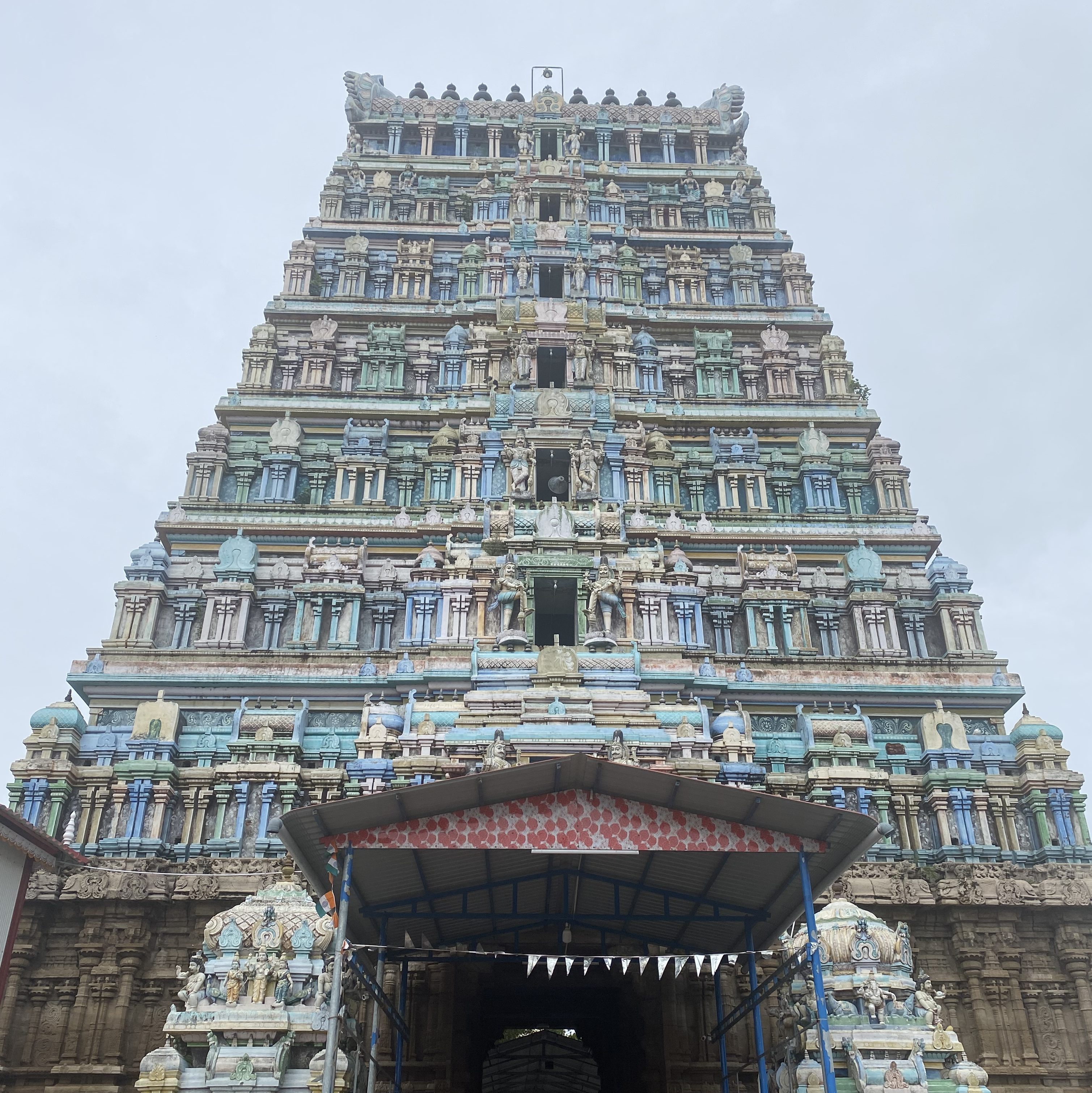
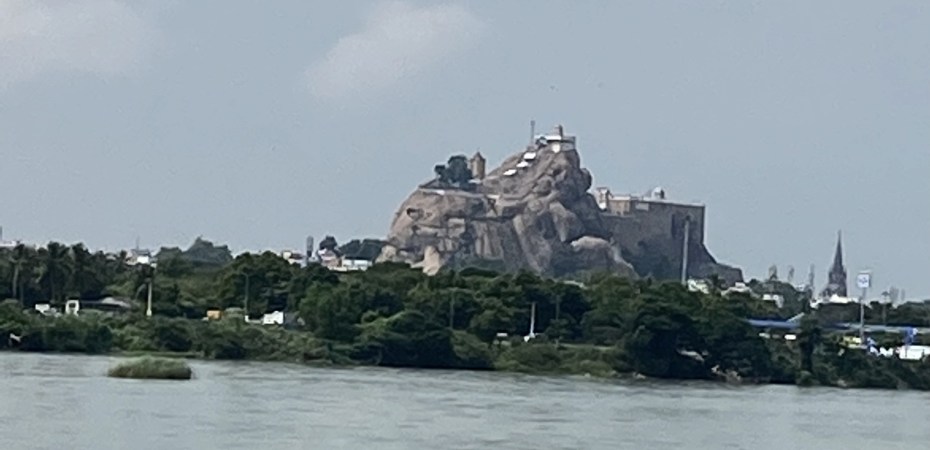
The 272 foot rock that defines the landscape of the city of Tiruchirappalli is one of the oldest rock formations- believed to be about 3.8 billion years old according to geologists. It houses rock cut caves & temples, the most famous of which are the Manikka Vinayagar at the foot , Thayumanavar in the middle and Uchchi Pullaiyar at the top.
The temples were built sometime in the 7th century by the Pallavas and later the Pandyas added to the construction.
Inscriptions refer to the place as “Siraappalli/சிராப்பள்ளி”, “Chitrambar”. References to the town also can also be seen in hymns composed on the deity here “Mathrubhutheswarar/Thayumanavar”.
Tevarams (7th century) refer to the place as “சிராப்பள்ளி” while Arunagirinathar (14th century) in his Thiruppugazh calls it “TriSiragiri/த்ரிசிரகிரி”.
There is text by the name “Sevvanthipuranam” in Thamizh which details the sthala puranam and other events associated with Tiruchirapalli.
Muthuswami Dikshitar, the 18th century composer-musician and one of the carnatic music trinity, has in his kriti “Sri Mathru bhutam hrid chintaye” referred to this sthalam as Trisiragiri while also providing a summary of the sthala puranam. He refers to Thayumanavar ( the one who became a mother too) as Trisiragirinatha ( the lord of the trisiragiri, the 3 headed mountain). Thayumanavar’s consort is “Mattuvar kuzhali” or “Sugandhakunthalamba” a reference to the Goddess’ frangrant tresses.
The rock underwent fortification during the Vijayanagara empire and further during the British rule and has witnessed many carnatic wars, after which it came to be known as Rockfort. Tiruchirapalli also came to be known as Trichonopoly under the British raj and now it’s simply “Trichy”.

 Kshetra Kshetrajna Yatra