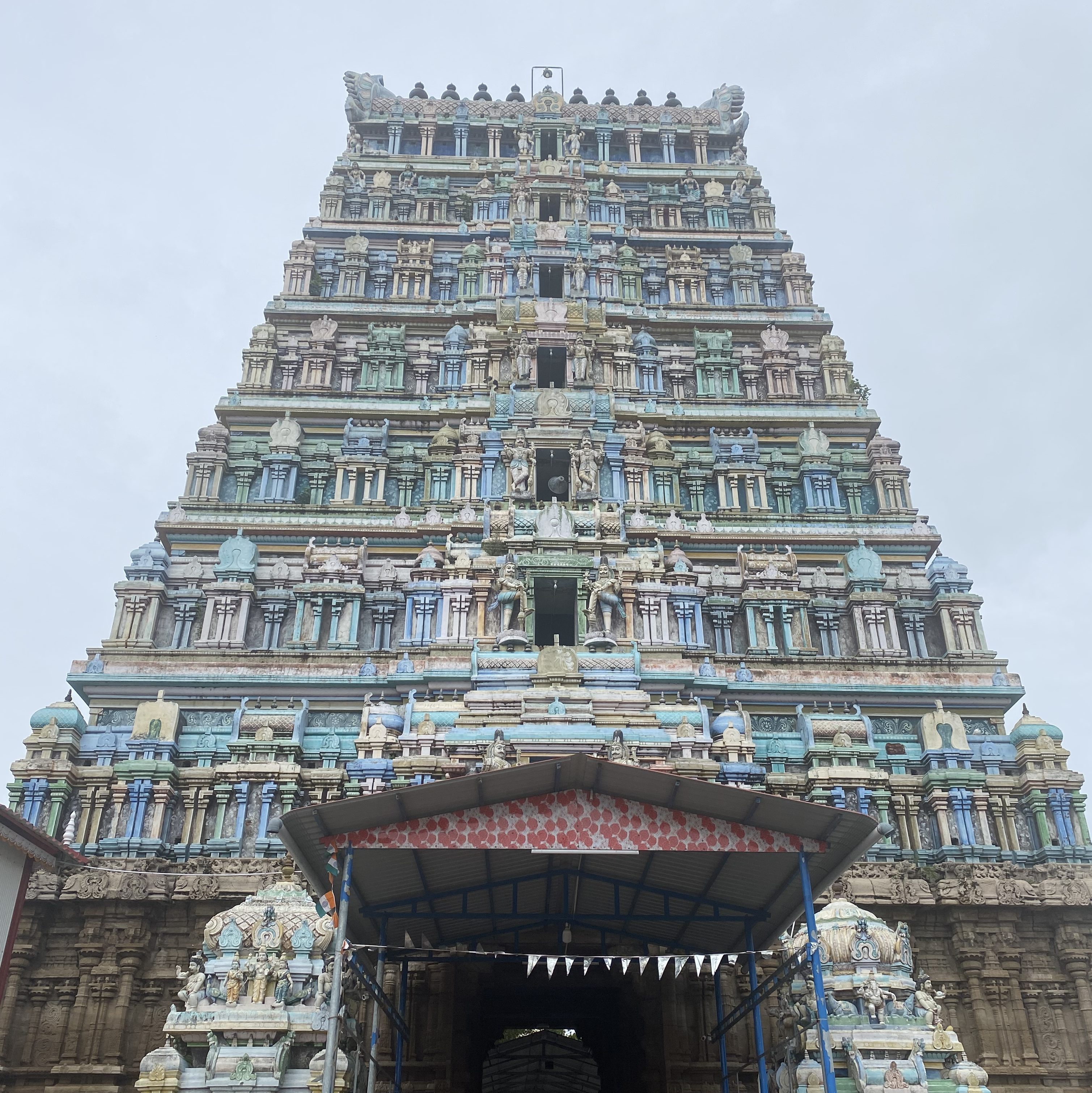

The month of Karthigai holds special significance in the worship of Swami Ayyappan. He is revered as the embodiment of the combined energies of Shiva and Vishnu. This is why he is also known as Hariharasuthan or Hariharaputra, meaning the son of Hari (Vishnu) and Hara (Shiva). The names Hariharaputra, Ayyappan, Ayyanār, and Shāstha are all used interchangeably to refer to the same deity, although subtle nuances exist.
Shāstha is the root deity, which is a complete form with both his consorts Pūrna and Pushkalā. Together, the trio represents the Ichcha (desire), Kriya (action) and Gnāna (wisdom) shaktis. Then comes the manifestation as Hariharaputra following which the various avatars of Shasthā manifest due to various reasons (mostly as a means destroy evil /negative tendencies depicted as asuras). Just like how we denominate ten prominent avatars of Vishnu, there are eight primary avatars or manifestations, referred to generally as Ashta Shāstas, with their own specific iconographic representations. Of these, the one that features in this yuga of Kali, is Ayyappan or Ayyanār.
There many texts in the purānas that have clearly described the details of who Shāstha is and his manifestations. The Skānda, Ganesa, Padma and Brahmānda puranās are some of the texts with references to the story of Shastha and Hariharaputra – of which the Lalitopākyana and Bhuthanāthōpākyanam give the most details.
Shāstha
The word Shāstha, in sanskrit, means “the one who governs” – the maker of all the rules that govern the universe.
The puranic account:
Once, the trimurthis Brahma, Vishnu, and Maheshwara performed intense penance to the Goddess Adiparashakthi from whom all the worlds manifested. Pleased with their penance, the goddess appears in front of them. Propitiating her from feet to head (pādadi keshāntha), they notice a certain glow when they reach the region of the heart. They then question what this divine radiance is, upon which the goddess instructs them to do further penance and seeking. The second time, the goddess appears and reveals that it is nothing but her mānasika putra, the one who resides in the million-petalled lotus of her heart (Hridāyaravindavāsi1) as a formless jyothi – the one by whose direction and command does the universe function. He is thus named Shāstha. The brilliance and aura are so beautiful that, in the goddess’ presence, both Shiva and Vishnu think in their minds, simultaneously, how wonderful it would be to have a son with these qualities. The goddess decides that the wish of both Vishnu and Shiva would come true at an appropriate time.
This account of the formless and at the same time, discrete ( nirguna-saguna brahman) nature of the divine has of course, mystic interpretations, but this is the first abstract conceptualization of Shastha from which the manifestations get propagated. The lighting of the makarajyothi on Sabarimala is a reference to this fundamental form of Shastha.
Hariharaputra – The son of Vishnu (Hari) and Shiva (Hara)
Avatāra rahasya
अम्बेति गौरीमहमह्वयामि पत्न्याः पितुर्मातर एव सर्वाः ।
कथं नु लक्ष्मीमिति चिन्तयन्तं शास्त्रं ईडे सकलार्थसिद्ध्यै ॥
Ambeti Gaurīm aham āhvayāmi patnyāḥ pitur mātara eva sarvāḥ |
kathaṃ nu Lakṣmīm iti cintayantaṃ śāstāraṃ īḍe sakalārtha-siddhyai ||
This famous verse composed by Appayya Dikshitar holds the conundrum or Avatāra rahayasa of HariHaraputra. It literally translates to “Having accepted Gowri (Parvati) as my mother, as all wives of my father (Shiva) are indeed my mothers (including the mohini form of Vishnu), then how would I address Lakshmi the consort of Vishnu ? I turn to Shastha to resolve this confusion and grant me wisdom “
अर्णोजनाभहरयोरिव मूर्तिमन्तं पुण्यातिरेकमिव भूतपतिं नमामि ॥
arNōjanābha harayōriva mūrtimantam punyātirekamiva bhūthapatim namāmi ||

"I bow to that pinnacle of virtues, Bhūtapati (the Lord of all beings), who is the unification of Vishnu (arnōjanabha - the one from whose navel springs a lotus) and Shiva (hara)" .

This constitutes another reference to the concept of Hariharaputra, the embodiment of the combined energies of Vishnu and Shiva, originating from the *kesādi-pādānta varnana stotram*, which is believed to have been composed by Adi Shankara.

These compositions and  other works of Appayya Dikshitar, such as the Harihara Abheda Stuti (prayer for Non-differentiation of Hari and Hara) serve to demostrate that there is no fundamental difference between the two paths.  Hariharaputra is the ultimate corroboration of this unity.
Manifestation of HariHaraputra
It is revealed in the puranas that the manifestation of HariHaraputra occurs after divine energies of Vishnu in the form of Mohini and that of Shiva combine. Now, there are seven different occasions (various Yugas, Kalpas) during which Vishnu is said to have appeared as Mohini and such accounts can be found scattered in various puranas such as Ganesha, Skānda,Padma and Brahmānda.
- Bhandasura vatham
- Vyālāsura vatham
- Virōchana vatham (Ganesha purānam)
- Destruction of the ego of the sages of Dārukā vanam (Shiva as Bhikshadanar and Vishnu as Mohini)
- Bhasmāsuran/Sūrpakāsuran vatham
- Amritha mathanam
Of all the narratives, the one of Amritha mathanam has been the most popularly recounted for the incarnation of HariHaraputra, as this story is found in many purānas and upākyānams such as Skānda, Padma and Brahmānda (Bhuthanāna Upākyānam and Lalithōpākyānam – where it is said that the goddess gives her own form to Vishnu)
Amritha Mathanam (The churning of the Ocean to obtain the nectar of Immortality)
The story of Sage Durvasa and the garland is the pivotal event that leads to the churning of the ocean. Durvasa, known for his explosive temper, obtained a divine, never-wilting garland from a celestial nymph. While wandering, he met Indra, the King of the Devas, who was riding his divine white elephant, Airavata. Pleased with Indra’s greeting, Durvasa gifted him the sacred garland.
Rather than wearing the garland, an arrogant Indra casually places it around the neck of Airavata and further, the elephant pulls the garland off and tramples it underfoot. Enraged by this perceived insult to his gift, Durvasa curses Indra and all the Devas with mortality and loss of all their power and wealth and the Airavata to become a wild elephant. To regain their lost strength and immortality, the Devas (gods) and Asuras (demons) form a temporary alliance to churn the ocean, using the Mount Mandara as the churner and Vasuki as the churning rope supported at the base by a giant tortoise (Kūrma avatar). Several divine objects emerge during the churning (Airāvata, Kāmadhenu, Kalpakavruksham, Chintāmani, Kaustubham, Mahalakshmi and so on) and finally the Hālahāla poison (which is consumed by Shiva) before Dhanvantari emerges holding the nectar of immortality.2 At this juncture, Vishnu in the form of Mohini (the enchantress) arrives and distributes the amrita to the devas including Indra who then regain immortality.
Union of Hari and Hara
After the Amrita mathanam episode, it is said that Vishnu returns to his abode Vaikunta and Shiva seeks to find out the secret of the Mohini avatar that Vishnu assumes. Vishnu then disappears into a Udyāna vana (a beautiful garden) filled with exquisitely beautiful flora and fauna and melifluous sounds. There, Shiva finds a ethereally beautiful maiden, who is none other than yoga māya, under a champaka tree, bedecked with jewelry playing with a gem studded ball. Entranced by this heavenly maiden, Shiva approaches her and holds her hand. In that instant, the energies of both merge as one and thus the manifestation of Shasthā as the son of Hari and Hara happens by the divine will of the Goddess – which also fulfills their individual wishes that each had in Her presence.
Ashta Shāsthās
There are eight forms of Shāstha that have manifested for various reasons each with their own specific iconography. These forms are described in works such as Dyāna Ratnavali.
- Ādhi Shāstha – This is the root and complete form with his consorts Pūrna and Pushkala (daughters of maharishi Satyapūrna). He is depicted holding a lotus and seated with one leg folded on the pedestal and the other(right) leg on the ground. This form is also referred to as Kalyāna Shastha. Considered swayambu, this is the appearance that is assumed once Hariharaputra is manifested and resides in the realm of Tejovati3
- Bāla Shāstha – Also called Dhanvatari Shāstha, this child form is shown holding a milk bowl or amrita kalasam
- Kāla Shāstha – manifested to save a devotee named Sōmasharma, shown riding a black elephant , with 4 hands , holding dandam, pāsam, trisūlam
- Sammōhana Shāstha – Shown riding a white elephant, with hands holding pāsam and ankusam , or sugarcane bow and arrows made of flowers (wearing red silk like Tripurasundari)
- Vidyā Shāstha (Gnāna Shāstha) – Holding a veena like Dakshināmurthi , with chinmudra, prayer beads and a book (vedās)
- Ārya Shāstha – Shown with consort Praba (king of Kāsi’s daughter) and son Satyakan (in a somaskanda-like despiction)
- Kirāta Shāstha – Shown holding a bow and arrow (as a hunter)
- Dharma Shāstha – In a yogic pose with both legs folded and feet facing forward , in deep meditation , chinmudra in one hand (This āsana is indeed referred to as Harivarāsana)
Ayyappa, Ayyanār
This is the form of Shāstha/Hariharaputra that is commonly worshipped in this yuga of Kali. Dharma Shāstha is believed to have incarnated as Manikanta in the southern region of India (Kerala) to destroy a demoness by the name Mahishi.
Mahishi is said to have obtained a boon that she could be vanquished only by a son born of Shiva and Vishnu and who must have served as a earthly human being for 12 years. Manikantan (with beaded chain around his neck , hence the name) appears in the land of Parasurāma, near the Pamba river and is fostered by the king Rajasekhara Pandian. He grows up as the son of Pandya vamsa (“Pandyesa vamsa thilakam, Kerale keli vigraham“) and one occasion of fetching the milk of a tigress, ventures in to the forest and destroys the demoness Mahishi.
This incarnation as Manikanta is generally referred to as Ayyappan in Kerala (similiar to Guruvayūrappan) and Ayyanār in Tamil Nadu (similar to Pillayār). Both the names have the root word “Ayyan” which is generally a way to address a greater being with respect (like “Aryan“)
Worship of Ayyappan is followed in many parts of India (In Andhra as Gurunāthan, Bengal as Dévōthaman, in Gujarat as Révathan) but in present days, the most established deities are Ayyappan in Sabarimalai and as Ayyanār in other parts on Tamil Nadu.
Footnotes:
- Hridayāravindavāsi -literally translates to “one who resides in the lotus of the heart. Ganapathi, Subramanaya, Bhairava and Ayyappa are considered the four mānasīkaputras of Shakthi. ↩︎
- This churning of the ocean is an allegory to the process of realization that happens within our own self. Meru (Mandara) is the spinal chord, with Vāsuki as the ida and pingala nādis represent our kundalini. The different objects that manifest during the churning are the different siddhis that one achieves during the process of ascending each chakra. Finally the Hālahāla which is the ego has to be consumed or eliminated completely to achieve immortality or realization. ↩︎
- Just like Shiva in Kailāsam, Vishnu in Vaikuntam, Brahma in Satyaloka, Ganesha in Swānandabhavanam, Subrahmanya in Skandagiri and Rāma in Sāketapuri, we speak of Shāstha in Tejovati. ↩︎
 Kshetra Kshetrajna Yatra